Trump Accounts: The Complete Guide for Parents and Grandparents (2026)
Written by: Allen Mueller, CFA, CFP®
Last updated: July 26, 2026
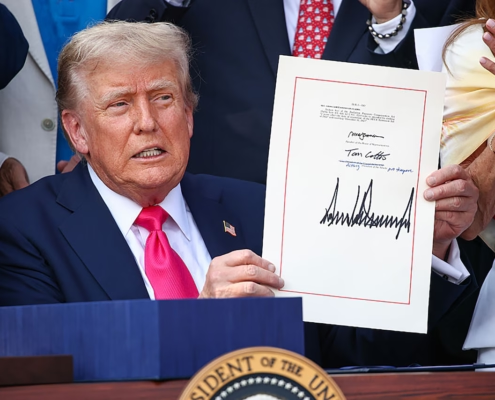
Starting July 4, 2026, a new account type called the Trump Account joined 529 plans, UTMAs, and custodial Roth IRAs as a way to save for kids. Most coverage has focused on the $1,000 government seed for newborns. The more interesting opportunity for families with means is something else entirely: using the account as a multi-decade backdoor Roth IRA for a child or grandchild.
Key Takeaways
- Trump Accounts launched July 4, 2026 as custodial-style traditional IRAs for any U.S. child under 18 with an SSN.
- Annual contribution limit is $5,000 per child from all sources combined, indexed for inflation after 2027. No earned income required.
- The real opportunity is the Roth conversion as a young adult, when the beneficiary is in low tax brackets. A small tax bill can unlock decades of tax-free growth.
- $5,000/year from birth could grow to ~$3.3 million tax-free by age 60, roughly a 30x multiplier on the parents’ or grandparents’ total outlay.
The Basics
A Trump Account (officially called a Section 530A account) is essentially a custodial-style traditional IRA created for a child. The Treasury administers the initial accounts, with rollovers to financial institutions like Fidelity and Schwab available after launch.
- Who’s eligible: Any U.S. child under age 18 with a Social Security number
- The $1,000 seed: A one-time government contribution, but only for children born in 2025, 2026, 2027, or 2028
- The $250 Dell family grant: Michael and Susan Dell have committed $6.25 billion to seed accounts with $250 each for up to 25 million children age 10 and under in zip codes with median family incomes of $150,000 or less. These are available for kids who are not eligible for the $1,000 government seed. Grants are first come, first served. Check eligibility.
- Annual contribution limit: $5,000 per child from all sources combined (parents, grandparents, employers), indexed for inflation after 2027
- No earned income required: Unlike a custodial Roth IRA, you can fund a Trump Account from birth — the child doesn’t need a job
- Investments: At launch, all contributions are invested in the SPDR Portfolio S&P 500 ETF (SPYM). Four additional low-cost index funds: iShares Core S&P 500 (IVV), Vanguard Total Stock Market (VTI), SPDR S&P 1500 (SPTM), and iShares Core Total U.S. Stock (ITOT) have been authorized, but the ability to reallocate across them won’t be available until Treasury rolls out that functionality in the coming months.
- Withdrawals locked until 18: Money is generally inaccessible during the “growth period,” which enforces long-term discipline
After the child turns 18, the account begins functioning like a traditional IRA. This is where the real opportunity opens up.
How Trump Accounts Compare to 529s, Custodial Roths, and UTMAs
| Feature | Trump Account | 529 Plan | Custodial Roth IRA | UTMA/UGMA |
|---|---|---|---|---|
| Contribution limit | $5,000/yr (all sources) | $19K/yr gift exclusion; 5-yr superfund | $7,000/yr (2026) | No limit |
| Earned income required? | No | No | Yes | No |
| Tax treatment of growth | Tax-deferred | Tax-free (qualified ed. use) | Tax-free | Taxable (kiddie tax rules) |
| Withdrawal rules | Locked until 18, then traditional IRA | Qualified ed. expenses anytime | Contributions anytime | Anytime |
| Best use case | Multi-decade Roth conversion play | Education funding | Teen with earned income | Flexible gifting |
| FAFSA treatment | Excluded (retirement) | Parent asset (~5.6%) | Excluded (retirement) | Student asset (~20%) |
| Roth conversion pathway | Yes, at age 18+ | $35K lifetime cap (SECURE 2.0) | Already Roth | No |
The Trump Account’s edge shows up in two places: no earned income requirement (so it can be funded from birth) and retirement account treatment for FAFSA (so it doesn’t torpedo need-based aid like a UTMA does).
The Backdoor Roth Strategy: Why This Matters for Wealth Transfer
Here’s the part most articles bury. The standard objection to Trump Accounts is that withdrawals of earnings get taxed as ordinary income. Unlike a Roth, where qualified withdrawals are tax-free, or a 529, where education withdrawals are tax-free, this looks like a meaningful disadvantage on its face.
But consider what happens when the beneficiary turns 18:
- The account converts to (or can be rolled to) a traditional IRA
- The new adult owner is almost certainly in a very low tax bracket as a college student or just starting their first job
- They can execute a Roth conversion at minimal tax cost, transforming tax-deferred growth into a Roth IRA they’ll never pay tax on again
Run the math on a child whose parents or grandparents fund $5,000 per year from age 0 to 17. At a 7% return, that’s roughly $182,000 by age 18.
Here’s where the tax treatment gets interesting: family contributions create basis in the account. So of that $182,000 balance, $90,000 is basis that comes back tax-free, and only the ~$92,000 of earnings is taxable on conversion.
But the account doesn’t stop growing at 18. By age 22 when the conversion begins, the balance has climbed to roughly $255,000, meaning the taxable earnings have grown to about $165,000.
Because a Roth conversion on $165,000 of earnings in a single year would push well into higher tax brackets, the smart play is to spread the conversion over multiple years (e.g. ages 22–26) while the beneficiary is in college or early career with minimal other income. Spreading across multiple years can keep most of the taxable income in lower brackets. Total tax cost could be estimated at around $20,000 on the entire account.
Ideally, this is paid by the parent or grandparent from outside the account as an additional gift, so the full balance lands in the Roth intact. Once converted, the money grows tax-free for the next 35+ years. By age 60, that Roth could grow to $3.3 million, every dollar of which comes out tax-free in retirement.
Adjust the sliders below to model your family’s scenario.
Trump Backdoor Roth Calculator
See how a Trump Account could grow for your child or grandchild. Contributions are allowed from birth until age 18. The account then converts to a Roth IRA over 4 years starting at the age you choose.
For illustration only. Actual returns will vary. This is not investment advice.
This illustration assumes taxes on Roth conversions are paid from outside funds, preserving the full account balance for tax-free growth.
Compare that to funding the same dollars into a taxable brokerage account, where annual dividends and capital gains create tax drag for decades. Or to a custodial Roth IRA, which requires the child to have earned income — unavailable during the early years when compounding matters most.
There’s also a useful technical quirk worth flagging: per IRS Notice 2025-68, a Trump Account is not aggregated with other IRAs for purposes of calculating the taxable portion of withdrawals or conversions. That means if the child later has a SEP-IRA from self-employment or a rollover IRA from a 401(k), the Trump Account stays in its own bucket. This gives you cleaner conversion sequencing and avoids the pro-rata rule headaches that plague backdoor Roth strategies for adults.
Who Should Consider This Strategy
The Trump Account backdoor Roth strategy is not for everyone, but for the right family it is one of the most tax-efficient wealth transfers available. It works especially well for families that:
- Have already maxed out their own retirement accounts and are looking for additional tax-advantaged space
- Are in a position to gift to children or grandchildren as part of an estate plan
- Want to instill long-term financial discipline (the account is locked until 18, period)
- Have a multigenerational view of wealth
How to Open a Trump Account
Over 6 million accounts have already been opened, and contributions begin July 4, 2026. Here’s how to get started:
- Open an account at trumpaccounts.gov. Parents have first priority, followed by legal guardians, adult siblings, and grandparents. The Trump Accounts app can also be used to open accounts, and it is available for Android and Apple devices. If you’re a grandparent planning to fund an account, coordinate with the parents first.
- Contribute up to $5,000 for 2026. The full annual limit is available for the partial 2026 calendar year — it’s not prorated. Contributions must be made by December 31, 2026 (there’s no prior-year contribution window like with IRAs).
- Roll over to your preferred custodian. Once funded, you can transfer the account to Fidelity, Schwab, Vanguard, or another institution that offers a Trump Account product. The rollover doesn’t change the account’s tax character or contribution eligibility, it just moves the account to a custodian with better service and investment options.
The Treasury has designated The Bank of New York Mellon (BNY) as the program’s financial agent, with Robinhood serving as brokerage and initial trustee. Direct account opening at a private custodian (skipping the Treasury intermediary) may become available over time, but the current path is Treasury first, rollover second.
For a detailed walkthrough of the account opening process, including what the activation email looks like, how contributions work, and common pitfalls — Kitces.com has an excellent step-by-step guide.
Don’t Forget the 529-to-Roth Rollover
Before going all-in on a Trump Account, the 529 plan has its own backdoor Roth pathway that’s arguably more tax-efficient. Under SECURE 2.0, up to $35,000 of unused 529 funds can be rolled over to a Roth IRA for the beneficiary (completely tax- and penalty-free), subject to annual Roth contribution limits, a 15-year account age requirement, and earned income on the beneficiary’s side. Fidelity has a helpful overview of the mechanics.
The practical implication: the most efficient stacking order is probably to max the 529-to-Roth pathway first (fund a 529 early, plan to roll $35K to Roth tax-free), then use the Trump Account for additional retirement-focused wealth transfer beyond that. The 529 wins on the education side and the first $35K of Roth conversion headroom; the Trump Account extends the strategy beyond that cap.
Addressing the Counterargument: Why Not Just Use a Taxable UTMA/UGMA?
Some advisors, notably the team at Kitces.com, have argued that a plain taxable custodial account beats a Trump Account on an after-tax basis. Their reasoning: kiddie tax rules create an effective 0% bracket on a child’s first $2,700 of unearned income each year, letting parents harvest gains tax-free and build basis over time.
It’s a fair critique, but it rests on two assumptions that don’t hold for most families doing multigenerational planning. First, it assumes the conversion tax gets paid from inside the account (triggering a 10% penalty), rather than by a parent or grandparent as an additional gift. Second, it assumes a single-year conversion at 22%, rather than spreading across 4 years in the 12% bracket.
The analysis also doesn’t account for the Roth’s structural advantages: no RMDs ever, no ongoing tax drag, FAFSA exclusion (UTMAs are assessed at 20% as student assets), and estate planning benefits for grandparents with taxable estate exposure.
Bottom line: if a family can’t cover the conversion tax from outside the account, the UTMA case is defensible. For families who can absorb that cost as part of a broader gifting plan, the Trump Account strategy generally wins — the end product is a tax-free Roth, which is qualitatively better than a taxable account with embedded gains.
There’s also an inheritance advantage worth noting. If the child eventually passes the Roth to their own heirs, the SECURE Act’s 10-year rule requires full distribution within a decade, but every dollar comes out tax-free. In practice, most heirs would let the account grow tax-free for the full 10 years before taking a single distribution. Compare that to inheriting a taxable brokerage account: the heirs receive a step-up in basis at death, but future growth is taxable. For families thinking in multigenerational terms, the Roth is the better long-term vehicle.
Getting It Right
- Over 6 million accounts have already been opened. Contributions begin July 4, 2026. The full $5,000 annual limit is available for the partial 2026 calendar year, it’s not prorated.
- Don’t miss the December 31 deadline. Unlike IRAs, there’s no prior-year contribution window. A 2026 contribution has to hit the account by 12/31/2026.
- Pay the Roth conversion tax from outside the account. Paying from inside triggers both ordinary income tax and the 10% early withdrawal penalty on the payment amount. Always pay from outside as an additional gift.
- Spread conversions across multiple years. Doing it all in one year pushes income into higher brackets. Spreading across 4 years in the 12% bracket can cut the blended tax rate by more than half.
- 529s are still better for college. If education funding is the primary goal, a 529 offers tax-free withdrawals for qualified expenses plus potential state tax deductions. A Trump Account is not a substitute.
- Some details may still evolve. The IRS is still issuing guidance, and the rollout will evolve through 2026 and beyond.
The Hair in the Soup
No strategy is perfect. Before you commit, here are the drawbacks worth weighing.
Skip the Roth conversion and you have a problem. Without converting, a Trump Account is just a tax-deferred account that will eventually be taxed as ordinary income in retirement. That means your child inherits a future tax bill on every dollar of growth — no step-up in basis, no capital gains treatment. A plain taxable brokerage account would actually be better in that scenario because long-term gains get preferential rates and inherited assets get a step-up in basis at death.
The kiddie tax can bite. If the beneficiary is not financially independent (generally before age 19, or 24 if a full-time student), unearned income above the threshold gets taxed at the parents’ marginal rate. That defeats the entire purpose of converting in a low bracket. This is why the Roth conversion strategy works best when the child is genuinely on their own: out of college, working, and filing independently.
Your child gets full access at 18. Once the beneficiary turns 18, the account is theirs to do with as they please. If they are not financially responsible, they could withdraw the funds, trigger taxes and penalties, and derail the entire strategy. There is no protection mechanism built into these accounts.
Gift tax filing depends on the safe harbor. The IRS confirmed in Rev. Proc. 2026-25 that Trump Account contributions are technically gifts of future interest. However, a safe harbor treats them as present interest gifts (eligible for the $19,000 annual exclusion) if all five conditions are met:
- The donor is an individual
- The only taxable gifts that year are cash contributions to Trump accounts
- Total gifts to each beneficiary (including the Trump Account contribution) stay under the annual exclusion
- No gift or GST tax is owed after applying the donor’s remaining exemptions
- No Form 709 is otherwise required or filed for any other reason
For most families making only Trump Account contributions, this means no Form 709 is needed. But here’s where it gets tricky for planning-oriented families: if a grandparent contributes $5,000 to a grandchild’s Trump Account and makes a $30,000 cash gift to an adult child in the same year, the adult child’s gift triggers a Form 709 — and that disqualifies the safe harbor, meaning the Trump Account contribution must also be reported as a gift of future interest. Families making gifts to multiple generations in the same year should coordinate with their tax preparer. Read more from Tom Talks Taxes.
Be sure to read our article on Everything You Need to Know About Gifting Money (and Why 99% of People Will Never Owe Gift Tax).
Frequently Asked Questions
When do Trump Accounts launch?
July 4, 2026. Account elections can be filed now via IRS Form 4547, but no contributions can be made before the launch date.
How do I open a Trump Account?
Visit trumpaccounts.gov to file IRS Form 4547 and open an account. You can also use the official Trump Accounts app for iPhone or Android. Parents have first priority to open, followed by legal guardians, adult siblings, and grandparents. There is no cost to open an account, and contributions begin July 4, 2026.
Can grandparents contribute to a Trump Account?
Yes. Anyone can contribute (parents, grandparents, other relatives, or employers) up to a combined $5,000 per child per year. Parents have first priority to open the account, but grandparents can fund an existing account.
Can I use a Trump Account for my own child, not just a grandchild?
Yes. Any U.S. child under 18 with an SSN is eligible. The multigenerational framing in this article reflects the most common use case for our clients, but the strategy works equally well for parents.
Is there an income limit to contribute?
No. Unlike a Roth IRA, there’s no income phaseout for Trump Account contributions.
Do I need to file a gift tax return for Trump Account contributions?
Not necessarily. Rev. Proc. 2026-25 provides a safe harbor that exempts you from filing Form 709 if you meet all five conditions: (1) only the child’s parents or grandparents contribute, (2) total contributions don’t exceed $5,000, (3) no contributions go to any other Trump Account that year, (4) the contributors make no other taxable gifts during the year, and (5) the contributors haven’t used any lifetime gift tax exemption. If you exceed any of these conditions — say a grandparent also gives a birthday gift above the annual exclusion — you’ll need to file.
Does the child need a job to have a Trump Account?
No. Unlike a custodial Roth IRA, Trump Accounts can be funded from birth with no earned income requirement.
Is my child eligible for the Dell family grant?
Children age 10 and under (born on or after January 1, 2016) who live in a zip code with a median family income of $150,000 or less are eligible for a one-time $250 contribution from the Michael & Susan Dell Foundation. The grant is funded by $6.25 billion earmarked for approximately 25 million children. Your child must have an open Trump Account to receive the deposit.
What’s the difference between a Trump Account and a 529 plan?
A 529 is designed for education and offers tax-free withdrawals for qualified expenses. A Trump Account is a traditional-IRA-style retirement vehicle with a built-in Roth conversion pathway at age 18. For education funding, use a 529. For multi-decade retirement wealth transfer, use a Trump Account.
Can I convert a Trump Account to a Roth IRA?
Yes. After the beneficiary turns 18, the account functions as a traditional IRA and can be converted to a Roth IRA. The family-contributed portion is basis (tax-free on conversion); the growth is taxable at the beneficiary’s ordinary rate.
How much tax will a Roth conversion cost?
On an account grown to roughly $255,000 by conversion age (from $90,000 in family contributions), about $20,000 total (based on current tax rate assumptions) if the conversion is spread across 4 years while the beneficiary is in the 12% bracket. A single-year conversion at 22% would cost closer to $36,000.
Does a Trump Account affect financial aid?
No. Like other retirement accounts, Trump Accounts are excluded from FAFSA asset calculations. This is a meaningful advantage over UTMAs, which are counted as student assets.
Is This Strategy Right for Your Family?
Trump Accounts are one of several tools we use at 7 Saturdays Financial to help clients transfer wealth to the next generation efficiently. Whether it’s the right fit depends on your broader estate plan, gifting capacity, and goals for your children or grandchildren.
If you’d like to talk through how a Trump Account fits alongside your 529s, Roth conversions, and overall retirement income plan, schedule a free Intro meeting.
About the author: Allen Mueller, CFA, CFP® is the founder of 7 Saturdays Financial, a fee-only, flat-fee advisory firm based in Dallas, Texas specializing in retirement income planning for those approaching or in retirement.
For a thorough overview of Trump Account mechanics, Fidelity has published a helpful primer.
This article is for educational purposes and does not constitute personalized tax or investment advice. Consult your advisor before implementing any strategy discussed here.