Whether you’re a new hire or a long-tenured RTX employee, your 401(k) is one of the most powerful tools in your retirement arsenal. This benefit is a critical element of your financial plan, and understanding the nuances of the plan can mean thousands (or even hundreds of thousands) of extra dollars in retirement.
Below are some of the most common questions about the RTX Savings Plan.
What is the RTX Savings Plan?
The RTX Savings Plan is the company’s primary 401(k) retirement savings plan, available to most RTX employees including those from legacy Raytheon, Pratt & Whitney, and Collins Aerospace divisions.
Prior to January 1, 2023, Raytheon employees participated in the Raytheon Savings and Investment Plan (RAYSIP). That plan, along with the legacy United Technologies plans, was merged into a single harmonized plan now known as the RTX Savings Plan.
If you’re a long-tenured Raytheon employee, the core structure of your plan will feel familiar, but there are some meaningful differences worth knowing.
How much does RTX contribute to my 401(k)?
RTX contributes to the plan in two ways:
1. Company Match
- RTX matches 100% of the first 3% of eligible compensation you contribute, and 33.3% on the next 3%, for a maximum match of 4% if you contribute at least 6% of your salary.
Let’s walk through a couple of scenarios:
- If you contribute 3%, RTX matches 100% of that 3%, for a total company contribution of 3%.
- If you contribute 6%, RTX matches 100% of the first 3% plus 33.3% of the next 3% (= 1%), for a total company contribution of 4%.
- Contributing less than 6% means you’re leaving free money on the table. At minimum, contribute enough to capture the full match.
2. Company Retirement Contribution (for eligible employees)
- Employees hired after December 31, 2009 may also receive an automatic non-elective company retirement contribution of 3%–9% of eligible compensation, regardless of whether you contribute anything yourself. The percentage is based on your age as of December 31 of the current plan year.
How much can I contribute to my 401(k)?
You can contribute up to 50% of your eligible compensation, up to the 2026 annual maximum of $24,500 between Roth and pre-tax contributions (+ catch-up contributions of $8,000 if over age 50, OR $11,250 if age 60-63).
BONUS: The plan also allows after-tax contributions, which can supercharge your retirement savings.
Using after-tax contributions, it’s possible to go above the “normal” 401(k) limit of $24,500 (plus applicable catch-up) and get up to $72,000 — or more with catch-up — into your account. This limit includes all employee contributions (pre-tax, Roth, after-tax) and employer contributions.
After you’ve filled up your employee limit between pre-tax and Roth contributions (and any catch-up), after-tax contributions enable you to shovel even more money into tax-advantaged accounts.
This maneuver is known as the “Mega Backdoor Roth.”
What is the “Mega Backdoor Roth”?
Below is a graphic showing how the different contributions stack to reach the $72,000 total limit (assuming younger than age 50).
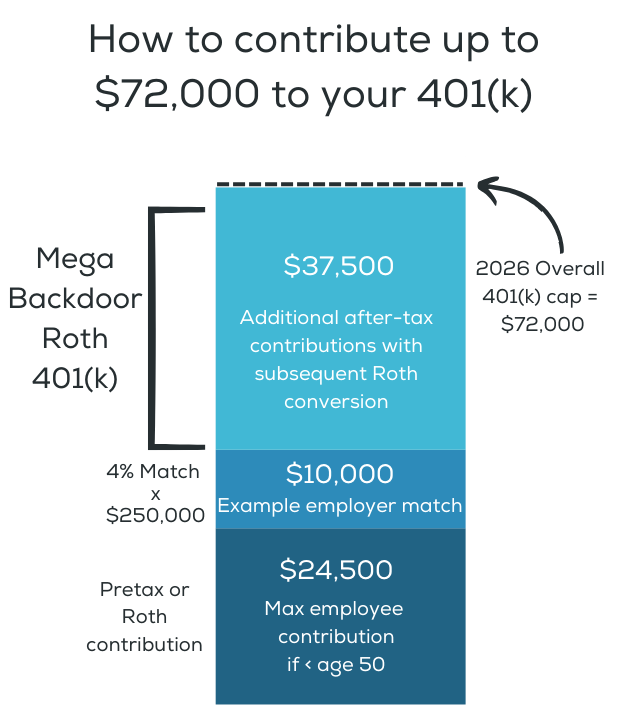
Here’s what makes the after-tax contributions valuable: they can be converted to Roth within the 401(k) plan. This is a great way to get an extra $30,000+ into a Roth account for tax-free growth and withdrawal (for qualified distributions).
It’s important to note that any earnings accumulated on the after-tax money between contribution and conversion WILL be taxable as ordinary income when converted. Thus, it is best not to let too much time elapse for earnings to build up. Consider converting after-tax to Roth at least semiannually.
If you contribute too much after-tax early in the year, it can “squeeze out” the employer match. RTX has to stay under the overall plan maximum and will reduce the match if necessary. A common practice is to go lighter on after-tax contributions in Q1–Q3, then reassess what’s needed in Q4.
How do catch-up contributions work?
Once you turn 50, the IRS allows you to contribute more than the standard limit through what are called catch-up contributions — an opportunity to accelerate savings as you approach retirement.
SECURE 2.0 added an enhanced “super catch-up” for ages 60-63, which allows an even larger contribution during those four years before reverting to the standard catch-up amount at 64.
The table below shows how the numbers stack up for 2026.
| Contribution Type | Under 50 | Age 50-59 | Age 60-63 | Age 64+ |
|---|---|---|---|---|
| Employee Deferral | $24,500 | $24,500 | $24,500 | $24,500 |
| Catch-Up Contribution | – | $8,000 | $11,250 | $8,000 |
| Total Employee Max | $24,500 | $32,500 | $35,750 | $32,500 |
| Total Plan Max | $72,000 | $80,000 | $83,250 | $80,000 |
Changes Due to SECURE Act 2.0: Starting in 2026, if you earned more than $150,000 in FICA wages in 2025, your catch-up contributions must be made as Roth (after-tax). Pre-tax catch-up contributions won’t be allowed above that income threshold. This is a significant change that will affect many RTX employees.
Should I choose Roth 401(k) or Traditional 401(k)?
The choice between Roth or Traditional (pre-tax) contributions is a personal one that depends on your financial situation and goals. Both options offer benefits, and deciding which one is right for you will depend primarily on your current tax bracket versus your expected future tax bracket.
The RTX traditional 401(k) offers an immediate tax break, as contributions are made with pre-tax dollars, lowering your taxable income in the current year. However, when you withdraw the funds in retirement, you will be taxed on the total amount of the distribution. This may be fine if your tax bracket is lower at that time.
There are other issues to consider beyond “tax bracket now vs. at retirement” including Required Minimum Distributions (RMDs) at age 73 or 75, income-based Medicare surcharges (IRMAA), and the potential for tax rates to change in the future.
Having a mix of pre-tax, Roth, and even taxable assets in retirement is a powerful position because you have tremendous control over your tax rate in any given year.
If you’re unsure which option is best for you, consult a flat-fee financial planner for expert guidance.
How much should I be contributing to my 401(k)?
Like many questions in personal finance, the correct answer is “It depends.”
The answer will vary based on factors like your current invested assets, retirement expense needs, other retirement income like Social Security, pensions, or annuities, and when you want to retire.
An employee without a pension who intends to retire at age 50 must save and invest much more than a colleague with a sizeable pension who wants to retire at age 65.
Many financial planning studies suggest that total retirement savings should average around 15-20% of gross income. However, you must run your personalized numbers to ensure you’re saving enough to retire at your desired age with your desired lifestyle.
At a minimum, contribute enough to capture the full RTX match — that’s a 6% contribution to get the full 4% match. Anything less is leaving guaranteed compensation on the table.
What can I invest in within my 401(k) plan?
The RTX Savings Plan offers a range of investment options through the RTX Savings Plan Master Trust, including:
- A stable value fund
- A Government/Credit Bond Index Fund
- Four equity index funds (U.S. large cap, U.S. small company, international developed markets, international emerging markets)
- Multi-asset class funds
- RTX company stock
The plan also offers target-date funds as a default option for participants who prefer a hands-off approach. These automatically adjust their asset allocation over time, becoming more conservative as you approach retirement.
For those who want access to a broader universe of funds, the plan offers a self-directed brokerage option as well.
Can I roll my old 401(k) or IRA into the RTX Savings Plan 401(k)?
Yes, the plan accepts rollover contributions. Before rolling money in, evaluate the account fees and fund costs between your old plan and the RTX Savings Plan.
One key benefit of consolidating pretax IRA money into a 401(k): once your pretax IRA dollars are sheltered inside a workplace plan, it opens the door to the Backdoor Roth IRA strategy — a way for high earners above the Roth IRA income limit to still get money into a Roth account.
Note that this is a different strategy from the Mega Backdoor Roth described above.
When are my contributions and company contributions vested?
Your own contributions are always 100% vested immediately — that money is yours from day one, regardless of how long you stay with RTX.
Company matching contributions vest after two years of service. If you leave RTX before completing two years, you would forfeit the unvested employer match. This is an important consideration when evaluating any job change early in your tenure.
The company retirement contribution (the age-based non-elective contribution for post-2009 hires) is generally subject to the same two-year vesting schedule as the match.
How will my RTX 401(k) fit with my legacy pension?
If you’re fortunate enough to have a pension, it’s important to understand all your options and how your income sources and assets fit together as part of your retirement income plan.
Frequently Asked Questions about the Raytheon pension plan can be found here.
Where do I go to manage my RTX 401(k)?
You can view your account balance, change your contribution rate, and make investment elections through the RTX benefits portal. The plan is administered through Your Gateway, RTX’s employee benefits platform.
I’m about to retire. How do I create retirement income from my 401(k)?
Accumulating money in your 401(k) is one thing, but turning it into reliable income that lasts 30+ years is a different challenge entirely.
How much can you safely spend? Which accounts do you draw from first? How do you coordinate your 401(k) with a pension and Social Security — and minimize your lifetime tax bill along the way?
These questions don’t have one-size-fits-all answers. Getting them wrong can mean retiring later than you planned, running out of money, or overpaying the IRS for decades.
At 7 Saturdays Financial, retirement income planning is our core focus. We specialize in helping pre-retirees and retirees — including RTX employees from Raytheon, Pratt & Whitney, and Collins Aerospace — build comprehensive plans that address not just investments, but spending strategy, tax efficiency, and the peace of mind that comes from knowing you have a plan that’s prepared for whatever life throws your way.
We’re a fee-only, flat-fee firm with no products to sell and no incentive tied to which funds you hold. Our only job is to help you retire with confidence and spend with clarity.
About the author: Allen Mueller, CFA, CFP®, is an “engineer turned finance nerd” and former Raytheon employee. He founded 7 Saturdays Financial in early 2022. The core focus of the 7 Saturdays Financial team is helping pre-retirees and retirees make the most of their “7 Saturdays a week”.
Visit www.7saturdaysfinancial.com to learn more. And be sure to check out the team’s ⭐⭐⭐⭐⭐ reviews at Wealthtender!
Note: this article is general guidance and education, not advice. Consult your money person or your attorney for financial, tax, and legal advice specific to your situation.
