
Why We Recommend Global Diversification

At 7 Saturdays Financial, we build portfolios of low-cost, broadly diversified funds, weighted toward the factors that decades of market data actually support. Every allocation decision follows the same test: does the evidence say this improves your odds of a successful retirement?
One key recommendation we make is to own companies from around the world. Nobody can reliably predict which country’s stock market will lead over the next decade, and concentrating a retirement portfolio in a single country turns that unknown into a real risk. A global portfolio keeps returns competitive and makes your retirement far less dependent on guessing which country performs best.
Why own the asset class that keeps losing?
If you’ve looked at a performance chart lately, you’ve probably asked some version of this question. US stocks have beaten international stocks for the better part of 15 years. So why would we deliberately hold the laggard?
It’s a fair question. The numbers are real. Anyone comparing a US index fund to an international one over that stretch would wonder the same thing.
Here’s the deal: the numbers are right, but the conclusion doesn’t follow. This post explains why we still recommend owning the world, why the last 15 years are a weaker argument than they appear, and why this matters even more once you’re drawing income from your portfolio.
Is going all-US playing it safe?
Quite the opposite. Let’s start by flipping the question around.
The United States makes up roughly 60-65% of the world’s stock market value. That means a globally diversified portfolio isn’t some exotic tilt toward foreign countries. It’s the neutral starting point. It’s what you own if you simply buy the world’s companies in proportion to their size, with no opinion attached.
Going 100% US is making a bet. It’s an active decision to zero out roughly a third of the world’s public companies, including names like Toyota, Nestlé, Samsung, Shell, and Louis Vuitton.
Think about it this way. Nobody would call a portfolio of only tech stocks “diversified” just because tech has led the market lately. Concentrating in one country is the same move, on a larger scale.
So the real question isn’t “why own international?” It’s “what would justify owning none?”
Will US stocks keep winning?
This is the heart of the objection, so let’s take it seriously.
First, the US winning streak is much shorter than it feels. Look at the last 50 years as a whole and you’ll find US and international stocks trading the lead back and forth for the first 35 of them. International dominated the late 1980s. The US ran the late 1990s. International won the 2000s. Essentially all of the cumulative US advantage over the full period showed up in just the last 15 years.
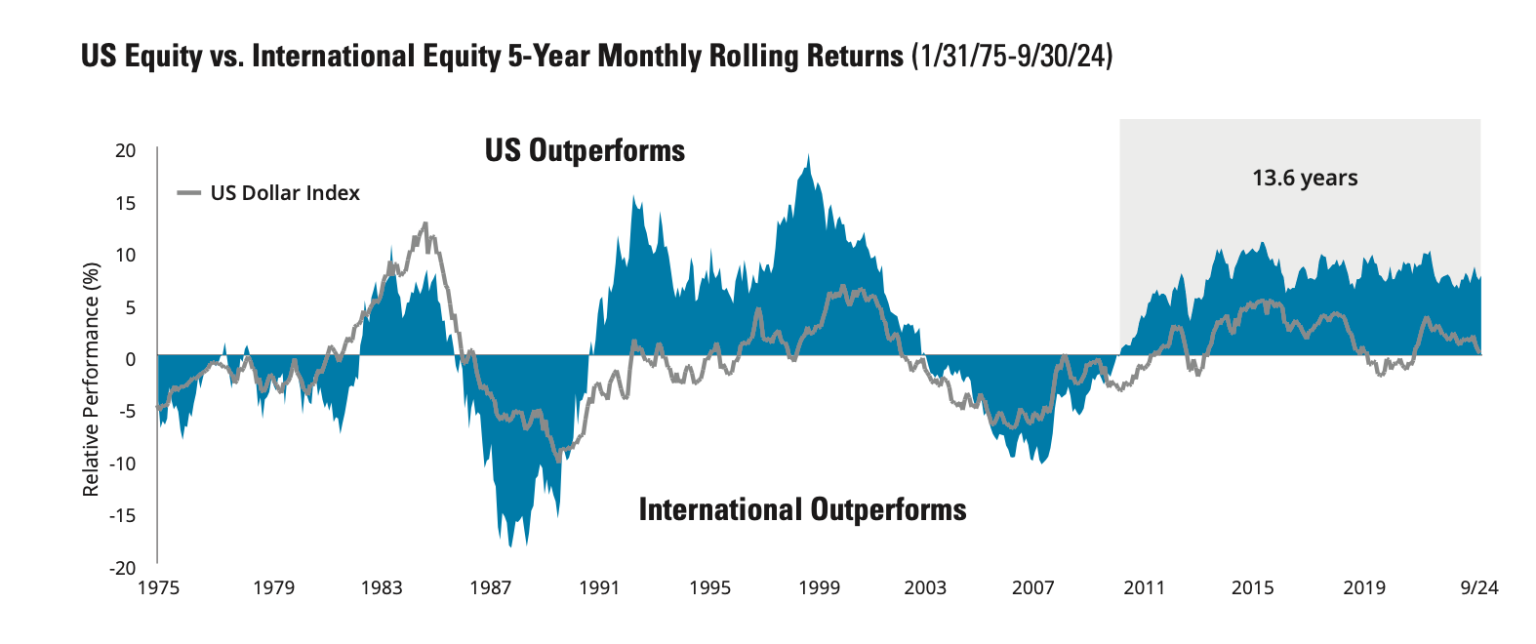
Source: Hartford Funds – US and International Markets Have Moved in Cycles
That changes the claim. “The US always wins” is really “the US has been winning.” Behavioral economists call this recency bias: our brains treat whatever happened most recently as the permanent state of the world. It’s the same instinct that made investors swear off stocks in 2009 and pile into tech in 1999. Fifteen good years feel like proof of something, but they’re one stretch in a much longer back-and-forth, and a very different premise to bet a retirement on.
Second, winning made US stocks expensive. This is the part most investors skip. When a market outperforms for years, its prices climb faster than its underlying earnings. You end up paying more for every dollar of profit. And starting valuation is one of the few things with real predictive power over the next decade of returns. The more you pay for an asset, the lower you can expect future returns to be (all else equal).
As of early 2026, US stocks trade near some of the highest valuation levels in their history, in the neighborhood of the late-1990s dot-com era. International markets trade much closer to their long-run norms. Forward-looking return estimates from firms like Vanguard now put expected international returns ahead of US returns over the coming decade. Note: we don’t recommend portfolio adjustments based on their fortune-telling.
None of the above guarantees international wins from here. But notice what it does to the original argument. Warren Buffett said it best: “The investor of today does not profit from yesterday’s growth.” The recent US run isn’t evidence the bet keeps paying. It’s the reason to not put all your eggs in one basket.
Third, you won’t catch the turn. Maybe you’re thinking: “we’ll ride the US while it works, then switch.” The problem is that leadership changes are only obvious in the rearview mirror. Look at country returns year by year and the top spot bounces around with no pattern: Denmark one year, the US the next, then Japan, then Spain. The country that tops the chart one decade rarely repeats the next. Nobody rings a bell when a new regime starts, and by the time the shift is undeniable, years of the new leader’s returns are already gone.
Since we can’t predict the reshuffle and can’t reliably react to it in time, one dependable move remains: own the winners before they’re obvious. That’s what global diversification quietly does every single year.
Do US multinationals give you global exposure?
This is a common argument, and it sounds reasonable. Apple sells iPhones in 175 countries. Microsoft, Coca-Cola, and Visa earn enormous shares of their revenue overseas. If you own the S&P 500, aren’t you already globally diversified?
No, and here’s why: where a company earns its revenue is not what drives its stock.
A US-listed stock is priced in dollars, trades on US exchanges, carries US valuations, and moves with US investor sentiment and US index concentration. When you buy the S&P 500, you own where the stocks trade, not where the customers live.
History makes this plain. From 2000 through 2009, US multinationals were every bit as global as they are now. Coke was in every country on Earth. Yet the S&P 500 went essentially nowhere for a decade while international and emerging markets posted solid gains. If multinational revenue delivered real diversification, that decade couldn’t have happened.
And you don’t have to reach back 20 years. In 2025, international stocks beat the US market by double digits, even though US mega-companies are more global than they’ve ever been.
Owning the customer base is not the same as owning the diversification.
What’s the goal: highest return or highest odds of success?
Investing involves two different games that feel identical but aren’t: maximizing your average return, and maximizing the odds you reach your goal.
Concentration stretches the range of outcomes in both directions. It raises your chance of the best result and your chance of the worst one. If your money exists to fund a specific life, the bigger downside costs you far more than the bigger upside is worth.
Diversification is a deliberate trade. You give up the home-run in exchange for a much lower chance of a strikeout. For a retirement portfolio, that’s a great deal because a strikeout isn’t a bad year – it’s a broken plan.
Does this matter more once I’m retired?
Yes, and this is the part most diversification articles miss. It’s also the part I care about most, because retirement income planning is what we do day in and day out.
A worker adding savings every month can wait out a bad decade. In fact, they benefit from it. If the stock market is down, every paycheck buys shares at depressed prices, and those cheap shares fuel the recovery.
A retiree selling shares for income has no such luxury. When you’re withdrawing during a deep, prolonged downturn, every sale locks in losses permanently. Shares sold at the bottom never recover, because you no longer own them.
This is sequence of returns risk. It means the path your portfolio takes matters more than the average return it earns. Two retirees can earn identical average returns and end up in wildly different places depending on when the bad years hit.
Now connect that to concentration. A single-country portfolio makes the worst-case paths both more likely and more severe, and a US-only lost decade is exactly the shape of path that breaks withdrawal plans. Global diversification narrows the path. It won’t eliminate bad stretches, but it dramatically reduces the odds that your entire portfolio stagnates for ten years while you’re drawing it down.
This is the same reason we use guardrails instead of static withdrawal rules. Retirement income planning is the art of protecting the plan from paths you can’t predict.
How much international is enough?
Our approach comes down to three principles.
- We size international deliberately. Enough to matter, not a token 5% that doesn’t move the needle.
- We rebalance on discipline, not headlines. When one region runs ahead, we trim it and buy what’s lagged. That’s the systematic rebalancing mechanism that captures the benefits of diversification over time.
- We don’t lurch. No jumping to all-US after a good US year, no piling into international after a good international year. The entire argument for diversification is that we can’t time these shifts. Acting like we suddenly can would defeat the purpose.
One honest note: diversification guarantees you will always own something that’s lagging. Every year, some slice of a global portfolio underperforms, and it’s tempting to ask why you own it. That discomfort is the fee for never being all-in on the loser. We think it’s the cheapest insurance in investing.
The bottom line
We recommend owning stocks from around the world because we can’t predict the future – and neither can anyone else. So we build plans that don’t require prediction.
You’ll never own only the winner. You’ll also never own only the loser. For a portfolio that has to fund 30+ years of retirement, that second guarantee is worth far more than the first.
This article is for informational purposes only and does not constitute investment, tax, or legal advice. It is not a recommendation to buy or sell any security. Market data cited reflects publicly reported figures as of publication.
About the author: Allen Mueller, CFA, CFP®, is an “engineer turned finance nerd” and founder of 7 Saturdays Financial, a wealth management firm based in Dallas, Texas.
The core focus of 7 Saturdays Financial is helping high performers retire with confidence and make the most of their 7 Saturdays a week.
If you’re interested in seeing if it’s a good fit to work together, the first step is to schedule a complimentary intro call.

