
The Retirement Risk No One Plans For

Most of the people we work with didn’t get to retirement by accident.
They got there by being disciplined. They maxed out their 401(k)s, lived below their means, avoided irresponsible debt, and said “not yet” to a lot of things they wanted along the way.
That discipline worked. It built the nest egg. It got them across the finish line.
But they kept saying no.
No to the trip. No to the kitchen renovation. No to flying the grandkids out for a week. Not because they couldn’t afford it – but because the habit of saying no had become part of who they were.
The same instincts that build wealth during your working years can quietly sabotage the retirement those years were supposed to fund.
And if you haven’t retired yet, this might matter even more to you than to people who already have.
The Switch That Won’t Flip
Accumulation and decumulation require completely different mindsets. During your working years, the right move was almost always to save more, spend less, and delay gratification. You did that for 30 or 40 years. It became automatic — part of your identity, really.
Then you retire, and the math changes. The whole point of the exercise was to build a pile of money you could use. But decades of conditioning don’t just evaporate because you had a retirement party.
I see this constantly. A couple in their early 60s, portfolio well into seven figures, agonizing over whether they can “afford” to take a trip they’ve talked about for years.
A retiree who keeps pushing Roth conversions to squeeze out every last tax advantage for the future, instead of using that money to do something at 65.
Here’s one that should make you uncomfortable: I’ve seen retirees whose net worth has grown every single year of retirement.
That sounds like a success story. But think about what it actually means — it means they’re spending less than their portfolio is generating.
Year after year, the gap between what they have and what they use gets wider. They are, by definition, not using the money they spent a career building.
And this isn’t a fluke. Decades of research on the 4% withdrawal rule — the foundation of most retirement income planning — show that retirees following it are dramatically more likely to die with more money than they started with than to run out. The math is lopsided. Most plans built around the fear of going broke end up funding an inheritance the retiree never intended to leave.
A portfolio that only grows in retirement isn’t a sign of good planning.
It might be a sign that the plan is failing at the one thing it was supposed to do.
Many retirees aren’t being irresponsible. They’re being *too* responsible. And it’s costing them something money can’t buy back: time.
Here’s the part that most retirement content ignores: this problem doesn’t start at retirement.
It starts at 57, when your knees are still good enough for that hiking trip through the Dolomites but you tell yourself you’ll do it “in retirement.” It starts every time you defer something you have the health and money to do right now because some future version of the plan feels more important than the present version of your life.
If you’re five or ten years from retirement and you’re still white-knuckling the accumulation phase, I’d ask you a simple question:
What are you waiting for?
You don’t need to blow up your savings plan. But the trip at 57 with healthy knees is worth more than the trip at 67 with a larger portfolio and a knee replacement.
What the Spending Data Actually Shows
This isn’t just a feel-good argument about “living your best life.” The data backs it up.
David Blanchett, formerly of Morningstar, tracked how retiree spending actually changes over time and published what’s now widely known as the “retirement spending smile.” Real spending (adjusted for inflation) tends to decline by roughly 1-2% per year through the middle decades of retirement.
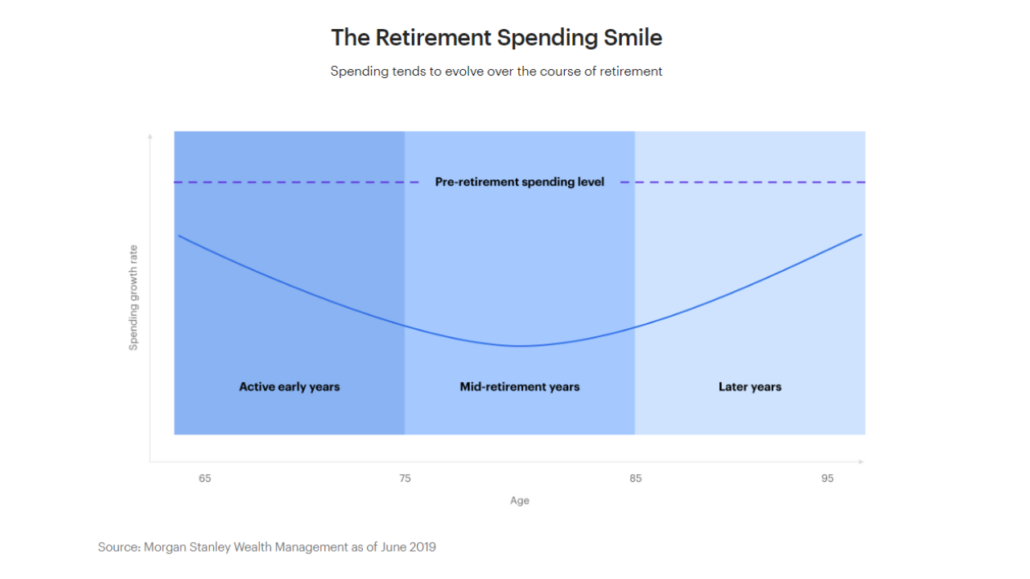
The driver isn’t frugality. People slow down. Energy fades. The body starts setting the terms. Healthcare costs eventually tick back up in very late retirement, but not enough to offset the broader decline.
Most retirement projections assume flat inflation-adjusted spending for 30 years. That’s not how people actually live. The years when you have the most capacity to spend are the same years when your plan has the most margin.
And yet those are exactly the years most retirees hold back.
Why the Switch Needs to Flip Now
Everything I’ve described so far — the mindset trap, the spending data — gets more urgent when you factor in one uncomfortable reality: your capacity to enjoy what you’ve saved has an expiration date.
In your 60s, if you’re reasonably healthy, you’re still you. You’ve got the stamina for a 14-hour flight to Tokyo, the endurance to spend a full day on your feet exploring a new city, and the flexibility to change plans on a whim. If you want to pick up a new language or train for a half marathon, your body will cooperate.
By your mid-70s, that starts to change.
You bounce back slower. A full day of activity wipes you out in a way it didn’t five years ago. The idea of connecting through three airports to get somewhere exotic starts to sound more exhausting than exciting. I’ve watched clients go from booking three-week trips to Europe to telling me they just don’t have the stamina for the flights anymore… and it happened faster than any of them expected.
By your 80s, the world gets smaller. More local. More routine. That’s not necessarily a bad thing — plenty of people discover real richness in a simpler life. But the version of you that could hike Patagonia or keep up with grandkids at the playground all afternoon? That person doesn’t stick around forever.
Which means the saver’s mindset isn’t just costing you money. It’s costing you the window when money can buy what you actually want.
The Real Risk Nobody Talks About
The financial planning industry is built around one fear: running out of money. Every Monte Carlo simulation, every safe withdrawal rate study, every stress test. They’re all designed to answer the same question: will I go broke?
It’s an important question. But in my experience, it’s rarely the thing that actually goes wrong.
Running out of money makes for a good fear. But for people who saved diligently, worked with an advisor, and built a real plan? It almost never happens. They were always going to be fine.
What they run out of is time. And energy. And the physical capacity to do the things they spent 40 years promising themselves they’d do.
The risk that actually materializes is the opposite one: reaching your 80s with a big portfolio and a long list of things you wish you’d done while you still had the energy.
That’s the risk nobody builds a plan around.
The industry has built a thousand tools to measure the probability of going broke. It has built zero tools to measure the probability of wasting your best years.
There’s no Monte Carlo simulation for regret. No probability-of-success score for “I wish we’d taken that trip when we were 65 instead of saying we’d do it next year.”
The Case for Caution (And Why It’s Still Not Enough)
I can already hear the objections, and I want to take them seriously. Nobody wants to run out of money and eat cat food in retirement.
Sequence of returns risk is real. If the market drops 30% in your first two years of retirement and you’ve been spending aggressively, that can do lasting damage to a portfolio. Healthcare costs are unpredictable and potentially enormous — a long-term care event can easily burn through six figures in a year. And we’re living longer than any previous generation, which means your money might need to last 35 years, not 25.
These are legitimate concerns. I think about them with every client plan we build.
But here’s what the “be cautious” argument misses: it assumes the solution to uncertainty is always to spend less. For most well-prepared retirees, that’s the wrong lever to pull.
The right lever is flexibility. A war chest of cash and short-term bonds covering a few years of spending means you’re not forced to sell stocks into a downturn. That’s what actually mitigates sequence of returns risk, not skipping the trip to Japan.
Dedicated reserves and proper insurance handle the healthcare unknowns. And a spending framework that adapts as conditions change handles the longevity question far better than just spending less across the board and hoping for the best.
Caution has a role. But caution as a default setting (without a specific threat it’s responding to) is just fear wearing a responsible-looking outfit.
What This Means for Your Plan
So what does a plan that accounts for all of this actually look like?
It starts with accepting that not every retirement year is created equal. A good retirement income plan should reflect how you’ll actually live — higher spending in the early years, when you have the health and energy to use it, and a natural decline as life gets quieter. If your plan models flat spending for 30 years, it’s almost certainly overstating the risk and understating what you can safely spend right now.
This is where a guardrails-based approach (which regular readers know I’m a fan of) changes the game. Traditional planning gives you a single number: “you can spend $X per year with a 85% probability of success.”
And then you’re second-guessing every purchase for the next 30 years. “We’re only at 85%… I won’t feel comfortable spending until we’re at 100%!”
Guardrails work differently. They set an upper and lower boundary around your spending, and they tell you in advance what events would trigger an adjustment.
If your portfolio grows beyond the upper guardrail, you get a raise. If it drops below the lower guardrail, you tighten the belt temporarily to keep the plan on track (and avoid cat food for dinner).
What that means in practice is that you can spend more confidently in your 60s — not because you’re ignoring risk, but because the plan has a built-in mechanism for responding to it. You don’t need to underspend “just in case” because the guardrails are the “just in case.” They replace the vague anxiety of “am I spending too much?” with a clear, rules-based answer.
And here’s the part that matters most for this conversation: guardrails don’t just give you a number. They give you permission. Permission to spend more during the years when spending has the highest return on your life. The system will course-correct if it needs to.
That’s a fundamentally different experience than staring at a Monte Carlo probability and trying to decide if an 85% chance you won’t run out of money is safe enough.
Three Moves This Week
Reading about this is one thing. Doing something about it is another.
Here are three moves you can make right now:
1. The $5,000 question
If I handed you $5,000 in cash right now and told you that you had to buy some fun by the end of the week — not bills, not savings, not the kids’ college fund — what would you do with it?
Most people freeze. They’ve spent so long optimizing every dollar that the muscle for spending on joy has atrophied. Some can’t come up with anything. Others come up with a list and immediately start talking themselves out of it.
Now consider the scale. If you have a $2 million portfolio, $5,000 is 0.25% of your net worth. It’s a rounding error. It’s less than what your portfolio moves on an average Tuesday.
And yet for a lot of disciplined savers, the idea of spending it on something purely enjoyable feels reckless.
That reaction is the problem this blog is about. If you can’t comfortably deploy 0.25% of your portfolio on something that brings you joy, the issue isn’t your finances. It’s the saver’s mindset that’s still running the show.
Do the exercise. Write down what you’d spend it on.
Then ask yourself why you haven’t.
2. Build a “use it” bucket
Most retirees think about their portfolio as one big pile. Every withdrawal feels like it’s coming from the same place, the place that’s supposed to last 30 years. That framing makes every discretionary purchase feel like a threat to your future.
Try this instead. Carve out an explicit annual amount ($20K, $30K, whatever fits your plan) that’s pre-authorized for experiences, travel, generosity, anything with an expiration date. Put it in its own account if that helps.
The point is that this money has already been blessed by the plan. Spending it isn’t a decision you need to re-litigate every time. It’s just doing what the money was set aside to do.
Pre-authorization removes the friction. And friction is what’s killing the trip.
3. Make a sunset list
Write out the things you’ve been telling yourself you’ll do “someday” like trips, projects, experiences, time with specific people.
Next to each one, write the realistic age window when you’d actually be able to do it well. The hike through Patagonia probably isn’t a 78-year-old activity. Coaching your grandson’s t-ball team has about a four-year window before he’s not playing t-ball anymore. The trip to see your college roommate in Seattle requires both of you to still be around and mobile.
Most of these items have shelf lives the saver’s brain refuses to acknowledge. Writing them down forces the acknowledgment. And once you see the list, the prioritization gets a lot easier.
The Hardest Part
The math of retirement planning? That’s the easy part.
The hard part is giving yourself permission to use what you’ve built. It’s flipping that mental switch from “save more” to “this is what the savings were for.” It’s accepting that the trip, the new car, the kitchen renovation, the gift to your grandchild’s college fund, those aren’t indulgences – they’re the whole point.
The people who get retirement wrong almost never go broke. They go quiet. They spend too little, too late.
They’re so focused on protecting the nest egg that they forgot what it was for.
You built the plan. You did the math. You were careful for decades so you could stop being careful.
So stop being too careful. While you still can.
About the author: Allen Mueller, CFA, CFP®, is an “engineer turned finance nerd” and founder of 7 Saturdays Financial, a wealth management firm based in Dallas, Texas.
The core focus of 7 Saturdays Financial is helping high performers retire with confidence and make the most of their 7 Saturdays a week.
If you’re interested in seeing if it’s a good fit to work together, the first step is to schedule a complimentary intro call.
Frequently Asked Questions
What is the biggest financial risk in retirement?
For disciplined savers, the biggest risk usually isn’t running out of money — it’s underspending. Research on the 4% rule shows retirees are far more likely to die with more money than they started with than to go broke. The real risk is reaching your 80s with a large portfolio and a long list of things you never did while you had the health and energy to do them.
Why do disciplined savers struggle to spend money in retirement?
Accumulation and decumulation require opposite mindsets. After 30 or 40 years of saving more, spending less, and delaying gratification, that behavior becomes part of your identity. It doesn’t switch off at retirement, so many retirees keep saying “not yet” to trips and experiences they can easily afford. Spending in retirement requires a specialized approach and different tools.
What is the retirement spending smile?
Coined from research by David Blanchett, the retirement spending smile describes how real, inflation-adjusted spending tends to decline by roughly 1–2% per year through the middle decades of retirement as people slow down, before healthcare costs tick up slightly in very late retirement. Most plans wrongly assume flat spending for 30 years, which overstates risk and understates what you can safely spend early on.
Does following the 4% rule mean I’ll run out of money?
Rarely. Decades of research show retirees following the 4% withdrawal rule are dramatically more likely to die with more money than they began with than to run out. Most plans built around the fear of going broke end up funding an unintended inheritance.
How can I give myself permission to spend more in retirement?
Three practical moves help: the $5,000 question (force yourself to spend a small set amount purely on joy), a pre-authorized “use it” bucket for travel and experiences, and a “sunset list” of experiences with realistic age windows. A guardrails-based spending strategy also gives you permission to spend more confidently because it tells you in advance what would trigger an adjustment.
What is a guardrails-based retirement spending strategy?
Instead of a single static withdrawal number, a guardrails approach sets an upper and lower boundary around your spending and defines in advance what portfolio changes trigger an adjustment. If your portfolio grows past the upper guardrail, you get a raise; if it drops below, you temporarily tighten. This lets you spend more confidently in your healthy early-retirement years because the plan self-corrects.

