
Trump Account Calculator: How Much Could Your Child’s Roth Be Worth?
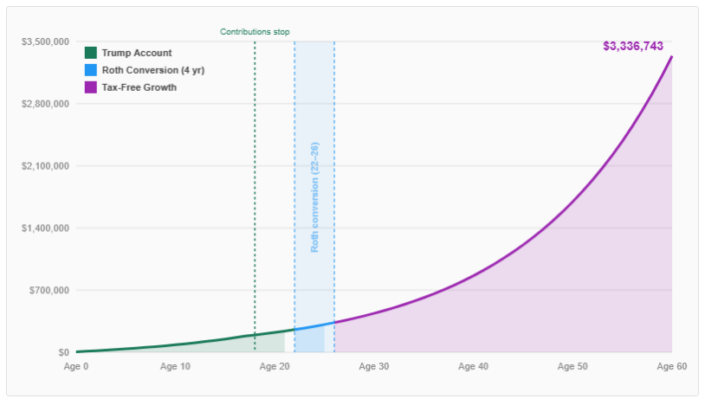
How much could a Trump Account grow if you started funding it today? We built an interactive calculator to help you find out.
The Trump Account (officially a Section 530A account) launches July 5, 2026, and allows families to contribute up to $5,000 per year per child into a tax-deferred account — no earned income required. The real power isn’t the account itself; it’s the backdoor Roth conversion you can execute once the child turns 18.
Our calculator models the full lifecycle: contributions from birth (or any starting age), tax-deferred growth, a multi-year Roth conversion in the child’s low-tax years, and decades of tax-free compounding afterward. Adjust the sliders to match your family’s situation.
Try the Calculator
Open the Trump Account Calculator →
The calculator lives on our complete Trump Accounts guide, which also covers the full strategy, comparison tables, and step-by-step account opening instructions.
What the Numbers Show
Here are a few scenarios to give you a feel for the math:
Newborn, $5,000/year for 18 years, 7% return: By age 60, the account grows to roughly $3.3 million tax-free in a Roth IRA. Total family outlay: $90,000. Estimated conversion tax (spread over 4 years in the 12% bracket): about $20,000. That’s a 30x multiplier on the parents’ or grandparents’ investment.
5-year-old, $5,000/year for 13 years, 7% return: The Roth grows to roughly $2.0 million tax-free by age 60. Starting later reduces the compounding runway, but the strategy still delivers a significant outcome.
Newborn, $3,000/year (more modest contribution): Even at a lower contribution level, the Roth reaches approximately $2.0 million tax-free by age 60. You don’t need to max the $5,000 limit to make this work.
Why This Matters
The Trump Account’s edge is the combination of three things: no earned income requirement (so you can fund it from day one), tax-deferred growth during the child’s highest-compounding years, and a clean Roth conversion pathway when they’re in their lowest tax bracket.
Compare that to a taxable brokerage account, where dividends and capital gains create drag every year, or a custodial Roth IRA, which requires the child to have earned income — unavailable during the years when compounding matters most.
The calculator helps you see the difference in concrete terms for your family’s specific numbers.
Key Assumptions
- Returns are assumed at the rate you select (default 7%), compounded annually. Actual returns will vary.
- Roth conversion is modeled over 4 years starting at the age you choose, with taxes estimated at the 12% federal bracket.
- The illustration assumes conversion taxes are paid from outside the account, preserving the full balance for tax-free growth. This is the recommended approach.
- This is for illustration only and is not investment, tax, or legal advice.
Next Steps
Run the calculator with your family’s numbers, then read the full Trump Accounts guide for the complete strategy — including how to open an account, the 529-to-Roth stacking play, and the gift tax rules you need to know.
Ready to Build Your Retirement Income Plan?
7 Saturdays Financial specializes in helping clients invest smarter, minimize their lifetime tax bill, and maximize their retirement income.
Get started with a free intro call.
About the author: Allen Mueller, CFA, CFP®, is an “engineer turned finance nerd” and founder of 7 Saturdays Financial, a wealth management firm based in Dallas, Texas.
The core focus of 7 Saturdays Financial is helping high performers retire with confidence and make the most of their 7 Saturdays a week.
This article is for educational purposes and does not constitute personalized tax or investment advice. Consult your advisor before implementing any strategy discussed here.

